Zinsco Panel Replacement: Why Insurers Demand It Gone
Learn why home insurers and inspectors reject Zinsco and Federal Pacific panels across Los Angeles, the fire hazards they create, and how panel upgrades protect your home.
If your home was built between the 1950s and the late 1980s anywhere in Los Angeles, the San Fernando Valley, or the San Gabriel Valley, there is a strong chance your electrical service relies on a ticking clock. Two brands dominate this era: Zinsco (often labeled GTE-Sylvania) and Federal Pacific Electric (FPE). What was standard equipment decades ago is now classified by fire investigators and electrical engineers as an active hazard. Today, homeowners face non-renewal notices from insurance carriers, failed real estate escrow inspections, and severe fire risks until they complete a zinsco panel replacement or swap out an aging federal pacific panel.
At AA Electrical Services, our licensed C-10 electricians have opened thousands of these enclosures across Burbank, Glendale, Pasadena, North Hollywood, and Santa Monica. The story is almost always the same: breakers that have fused permanently to the bus bar, heat damage hidden behind the dead front cover, and circuits that will not trip under a dead short.
The Engineering Flaws Behind Every Dangerous Electrical Panel
To understand why a building inspector or insurance underwriter flags these units, you have to look at the mechanical design inside the cabinet. A circuit breaker has one primary job: cut power before copper wiring inside your walls overheats and ignites framing lumber or drywall paper. When a panel fails to interrupt an overload, it ceases to be a safety device and becomes an ignition source.
The Federal Pacific Electric (FPE) Stab-Lok Failure
During the building boom of the 1960s and 70s, FPE Stab-Lok panels were installed in millions of American tract homes and multi-family apartment complexes. Independent testing by electrical engineers—most notably forensic engineer Dr. Jesse Aronstein—demonstrated that significant percentages of FPE Stab-Lok breakers failed to trip when tested under standard Underwriters Laboratories (UL) overcurrent conditions.
Key issues with FPE equipment include:
- No-Trip Failures: Certain two-pole Stab-Lok breakers fail to trip under severe overload conditions more than 30% of the time.
- Jamming Mechanisms: The mechanical linkage inside the breaker can bind, preventing the trip latch from separating the electrical contacts.
- UL Standard Deceptions: The Consumer Product Safety Commission (CPSC) investigated FPE in the early 1980s, revealing that the manufacturer used fraudulent testing practices to secure their original UL listing. Although the agency closed the probe due to budget constraints, the industry consensus remains clear regarding the fpe stab lok recall and safety profile: the design is inherently defective.
The Zinsco and Sylvania Meltdown Hazard
Zinsco panels present a different, equally destructive failure point: the connection between the breaker clip and the central bus bar. Instead of copper, Zinsco relied on an aluminum alloy bus bar paired with spring-clip breaker connections.
Over years of standard heating and cooling cycles, these metals expand and contract at different rates:
- Oxidation and Resistance: Aluminum oxidizes when exposed to air, creating electrical resistance.
- Thermal Runaway: High resistance generates intense localized heat, which softens the bus bar and degrades the clip.
- Arson-Like Fusing: The breaker clip literally welds itself to the bus bar. Once fused, the breaker cannot be pulled out by hand, and the internal bimetal strip often fails to release during an overcurrent event.
- False Sense of Security: The breaker handle might read "OFF," but current continues to arc across the degraded connection, energizing the circuit inside your home.
Why Homeowners Insurance Carriers Refuse Coverage in California
California's residential insurance market is under unprecedented strain. Underwriters are aggressively eliminating exposure, and standard 4-point insurance inspections specifically screen for known hazard brands. If an inspector photographs an FPE Stab-Lok or Zinsco emblem on your service cabinet, your insurer will likely issue a strict 30-day notice to replace it or face policy cancellation.
Here is how this impacts homeowners in the greater Los Angeles area:
- Policy Denials During Escrow: Buyers cannot secure a mortgage without hazard insurance. Discovering a dangerous electrical panel during the physical inspection can derail loan approval 48 hours before closing.
- Shift to Surplus Lines: Being forced onto specialty surplus lines or the California FAIR Plan leads to significantly higher annual premiums and reduced coverage limits.
- Post-Fire Claim Disputes: If an electrical fire traces back to an uncertified, altered, or known defective panel that was flagged on an earlier underwriting report, claims processing can become a legal nightmare.
Modern Power Demands Expose Hidden Weaknesses
When these panels were installed in 1968, a typical Los Angeles household ran a refrigerator, a color television, a vacuum, and lighting. The standard service capacity was often 60 to 100 amps.
Modern households demand far more electrical infrastructure:
- Continuous 32-amp to 48-amp EV charging equipment
- Central multi-ton heat pumps and air conditioning condensers
- Induction cooktops, sub-zero refrigeration, and electric tankless water heaters
- Home offices with multi-monitor computer arrays and dedicated server equipment
Placing sustained high-draw appliances on an old Zinsco or FPE bus bar creates continuous elevated temperatures. Where a modern Eaton, Siemens, or Square D panel handles these steady continuous loads without distress, an oxidized Zinsco bus bar quickly reaches temperatures high enough to char the back of the enclosure.
Quick Comparison: Obsolete Panels vs. Modern Electrical Panels
| Feature | Zinsco / Sylvania | FPE Stab-Lok | Modern 200A Panel (Square D / Siemens) | | :--- | :--- | :--- | :--- | | Bus Bar Metal | Aluminum / prone to pitting | Copper-clad or aluminum | Heavy-duty copper or plated aluminum | | Trip Reliability | Breakers weld to bus; fails | Documented 25-60% failure rates | Precision thermal-magnetic / electronic | | AFCI / GFCI Protection | Not natively supported | Not available | Full breaker-level arc/ground protection | | Insurability | Widely blacklisted in CA | Widely blacklisted in CA | Fully insurable by all standard carriers | | EV / Solar Ready | No; dangerous to tap | No; severe fire risk | Yes; dedicated subfeed and solar lugs |
Signs You Should Not Wait for Escrow or an Insurance Notice
Do not assume your panel is safe simply because the lights turn on when you flip a switch. These systems fail silently behind closed metal doors. If you notice any of the following symptoms in your home, schedule an inspection through our services page immediately:
- Breakers That Cannot Be Reset: A breaker trips, but when switched firmly to off and then on, it feels mushy, loose, or fails to latch.
- Discoloration on the Enclosure: Look for scorched paint, soot marks near breaker handles, or a distinctive yellowing of the breaker plastic casing.
- Buzzing or Sizzling Sounds: A continuous hum under heavy load indicates electrical arcing between the bus bar and the breaker stab.
- Warm Cabinet Face: Placing the back of your hand against the dead-front panel should never reveal hot spots.
- Flickering Lighting When Motors Start: When your refrigerator or HVAC compressor turns on, excessive voltage drop across poor panel connections will cause interior lights to dip sharply.
LADBS Permitting, Utility Coordination, and Replacement Costs
Replacing an obsolete electrical panel in the City of Los Angeles requires strict compliance with current California Electrical Code (Title 24) standards. This is not a simple swap-and-go job.
A legitimate, safe service upgrade involves several critical steps:
- Permits & Plan Review: Pulling electrical permits with the Los Angeles Department of Building and Safety (LADBS) or local municipal building departments in Glendale, Burbank, or Pasadena.
- Utility Spotting & Coordination: Coordinating with the utility provider—whether LADWP or Southern California Edison (SCE)—for service disconnection, proper meter clearance, and utility service point approval.
- Grounding Infrastructure: Modern code mandates the installation of two 8-foot copper ground rods driven six feet apart, along with bonding to the interior cold water piping system and gas line.
- Surge Protection and Arc-Fault Upgrades: Adding whole-home Type 2 surge protective devices (SPD) and AFCI protection to living space branch circuits.
What Drives the Cost?
Permitted panel upgrades generally range between $3,500 and $7,500 depending on the scope. Key factors that dictate your final investment include:
- Service Relocation: If your current panel sits in a breezeway, closet, or directly below a gas meter that violates current clearance codes, the main feed must be moved.
- Underground vs. Overhead Service: Underground conduit transitions require trenching and coordination with city utility vaults.
- Main Lug Capacity: Upgrading from a 100-amp service to a 200-amp service frequently requires LADWP or SCE to pull heavier gauge drop conductors from the alley transformer.
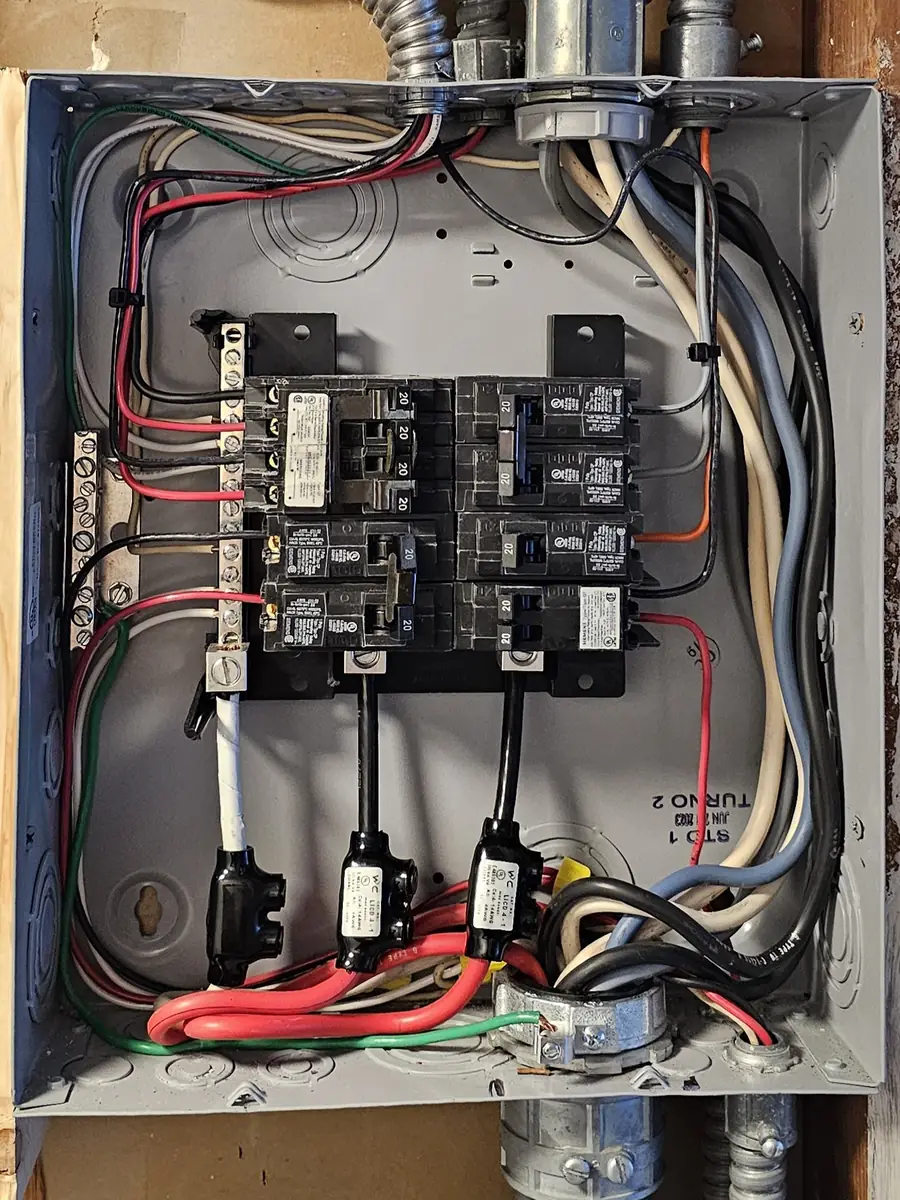
Frequently Asked Questions
Can I simply replace the breakers inside my Zinsco or FPE panel with new aftermarket ones?
While aftermarket replacement breakers are manufactured for Zinsco and FPE panels, installing them does not solve the underlying hazard. In a Zinsco panel, the bus bar itself is usually pitted, corroded, or burned; sliding a new breaker onto damaged bus contacts accelerates heat buildup. In an FPE panel, the enclosure and bus design remain fundamentally flawed. Insurance companies will still refuse coverage because the original, uninsurable enclosure remains in the wall. A complete cabinet and service replacement is the only lasting, code-compliant solution.
How long does a panel upgrade take, and will my power be off all day?
For a typical single-family home in Los Angeles, the physical swap takes roughly 6 to 8 hours. Our team coordinates directly with LADWP or SCE to disconnect the power in the morning. We strip out the existing equipment, install the new UL-listed cabinet, land all branch circuits, establish new grounding rods, and call for city rough inspection. Power is generally restored the same evening, minimizing disruption to your refrigeration and household routines.
How do I confirm what brand of panel is currently installed in my house?
Open the outermost door of your electrical cabinet (do not unscrew the internal protective cover plate). Look for original manufacturer stickers inside the door. FPE panels feature the distinctive "Stab-Lok" emblem or red toggle levers on the breakers. Zinsco panels typically display the "Zinsco," "GTE Sylvania," or "Kearney" brand mark, often with bright blue, green, and red breaker handles. If labels have faded, contact our team to perform a professional visual evaluation.
Will replacing my panel trigger other expensive wiring requirements throughout the house?
In most Los Angeles jurisdictions, swapping your service panel does not require rewiring your entire home. The existing branch circuits (even legacy ungrounded Romex or cloth-wrapped wiring) can be landed inside the new panel. However, code does mandate that new panels incorporate modern ground bonding, dual ground rods, and AFCI/GFCI protection on modified circuits to keep the home safe.
Protect Your Home and Secure Your Coverage
Living with an obsolete panel means leaving your largest investment vulnerable to preventable electrical fires and sudden insurance cancellation. Since 1991, AA Electrical Services has provided homeowners throughout Los Angeles, Van Nuys, Pasadena, and surrounding communities with honest diagnostics, clean craftsmanship, and permitted panel installations.
Stop wondering if your breakers will trip when you need them to. Call (818) 437-6736 today to speak directly with an experienced electrician, or submit your project details online through our simple form to get a free estimate.